
Showing posts with label G321 Preliminary task. Show all posts
Showing posts with label G321 Preliminary task. Show all posts
Monday, 5 November 2012

Sunday, 4 November 2012
"How to shoot a conversation"
There are various shots and techniques used when shooting a conversation all of which are there to help the scene flow smoothly or evoke an emotion, reaction or feeling from the consumers.
There is no a doubt several conversations in every single film that has ever been produced. Because of the fact conversation within a film is inevitable it can mean for repetitive, boring scenes.
Directors continue to capture the interest of consumers when filming these -some what boring- scenes by adding interesting and varied shots and angles. They ensure they capture certain clips that prompt consumers to have an opinion and evoke particular emotions.
Common shots used when shooting a conversation:
-2 mid shots (often over the shoulder and from several distances)
-A wide shot that tends to show all characters (this is usually the master shot throughout the scene)
-Close ups/Birds eye (commonly used for pick ups)
When shooting a conversation in a lower budget film often only one camera is used. Four takes would need to be shot:
1) Master shot
2) Character 1 MS
3) Character 2 MS
4) Pick ups
This would take quite a while edit. Whereas a film with a bigger budget tends to only use two cameras when shooting a conversation:
1) Master shot + Pick ups
2) Character 1 MS/ Character 2 MS
The less camera's required on set, usually, the better the scene for this would increase editing time and continuity ultimately resulting in a more fluent scene.
In most films, when shooting a conversation there will be close ups and cutaway shots of significant objects or expressions. For example, in this clip of The Hunger Games there was a cutaway showing a high angle shot of 'Prim' passing the protagonist a pendent. This makes the consumer remember the pendent and assume that this object has some significance and makes us question why? It also makes the conversation scene more visually interesting.
Close ups are also very useful when trying to add emotion to the conversation. Whether the emotion is sadness, anger or fear a close up of a characters , can be so powerful in getting that emotion across without using any dialog.


Shot/reverse shot is a film technique used constantly when filming a conversation...
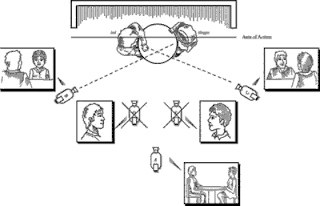 The shots used when filming a basic shot/reverse shot are establishing shots of the two characters, either a wide shot or mid shot. This differentiates the two characters and if needs be can clearly show the antagonist and the protagonist.
The other shot, an over the shoulder shot of each character. This way the consumer can see that the two characters are talking to one another.
This clip is a clear example of shot/reverse shot.
One of the most basic continuity rules is the 180 degree rule. Though, just because there are 'rule' when film making it does not necessitate that one should follow them. In fact a lot of directors tend not to (e.g Tarantino). However, there is a huge difference in consciously breaking the rule for a purpose and breaking the rule because you are an inexperienced film maker. If not done correctly, breaking the 180 degree rule can make for an amateur-like, confusing scene or film.
So, unless you are a very well established and creative director, it is a rule advised to follow at all times. When shooting a conversation it is important to set the scene and establish your characters in order for viewers to follow the conversation. Use of the 180 degree rule makes the scene seem more realistic and ensures that audiences do not get confused of the characters positioning in the scene. The is especially essential if the conversation is serious and needs to be carefully listened to and followed.
Sound and lighting can make a massive impact on a scene. Light connotations often evoke thoughts and feelings, and can determine the mood of the scene. Lighting can also put emphasis on certain characters/objects within the scene for example...
 In this scene of Casino Royale Bond is wearing all black and is sitting with the lights turned off, the lighting coming in from the window is shinning on James' face. We cannot see the rest of his body, just his face. This use of lighting makes the whole scene feel enigmatic, and keeps viewers on edge, because we cannot clearly see what his hands or the rest of his body is doing so what will happen next is unknown.
Sometimes sound is played over the top of a conversation. Often to add to the sadness or drama of the scene and determine the pace of the scene. This can be very effective in a slow, sad scene because it can really consume the viewer and encourage emotion or feeling. Alternatively sound in a more fast paced, scary scene can also be very useful in building up to a climax (just think, without that all important sound clip every time something bad was about to happen in Jaws, no one would know what was going on!)
However, sometimes certain music can be distracting and can take away from the seriousness of a conversation or a scene sometimes resulting in an anti-climax.
There is no a doubt several conversations in every single film that has ever been produced. Because of the fact conversation within a film is inevitable it can mean for repetitive, boring scenes.
Directors continue to capture the interest of consumers when filming these -some what boring- scenes by adding interesting and varied shots and angles. They ensure they capture certain clips that prompt consumers to have an opinion and evoke particular emotions.
Common shots used when shooting a conversation:
-2 mid shots (often over the shoulder and from several distances)
-A wide shot that tends to show all characters (this is usually the master shot throughout the scene)
-Close ups/Birds eye (commonly used for pick ups)
When shooting a conversation in a lower budget film often only one camera is used. Four takes would need to be shot:
1) Master shot
2) Character 1 MS
3) Character 2 MS
4) Pick ups
This would take quite a while edit. Whereas a film with a bigger budget tends to only use two cameras when shooting a conversation:
1) Master shot + Pick ups
2) Character 1 MS/ Character 2 MS
The less camera's required on set, usually, the better the scene for this would increase editing time and continuity ultimately resulting in a more fluent scene.
In most films, when shooting a conversation there will be close ups and cutaway shots of significant objects or expressions. For example, in this clip of The Hunger Games there was a cutaway showing a high angle shot of 'Prim' passing the protagonist a pendent. This makes the consumer remember the pendent and assume that this object has some significance and makes us question why? It also makes the conversation scene more visually interesting.
Close ups are also very useful when trying to add emotion to the conversation. Whether the emotion is sadness, anger or fear a close up of a characters , can be so powerful in getting that emotion across without using any dialog.


Shot/reverse shot is a film technique used constantly when filming a conversation...
wherein one character is shown looking (often off-screen) at another character, and then the other character is shown looking "back" at the first character. Since the characters are shown facing in opposite directions, the viewer unconsciously assumes that they are looking at each other.
 The shots used when filming a basic shot/reverse shot are establishing shots of the two characters, either a wide shot or mid shot. This differentiates the two characters and if needs be can clearly show the antagonist and the protagonist.
The other shot, an over the shoulder shot of each character. This way the consumer can see that the two characters are talking to one another.
This clip is a clear example of shot/reverse shot.
One of the most basic continuity rules is the 180 degree rule. Though, just because there are 'rule' when film making it does not necessitate that one should follow them. In fact a lot of directors tend not to (e.g Tarantino). However, there is a huge difference in consciously breaking the rule for a purpose and breaking the rule because you are an inexperienced film maker. If not done correctly, breaking the 180 degree rule can make for an amateur-like, confusing scene or film.
So, unless you are a very well established and creative director, it is a rule advised to follow at all times. When shooting a conversation it is important to set the scene and establish your characters in order for viewers to follow the conversation. Use of the 180 degree rule makes the scene seem more realistic and ensures that audiences do not get confused of the characters positioning in the scene. The is especially essential if the conversation is serious and needs to be carefully listened to and followed.
Sound and lighting can make a massive impact on a scene. Light connotations often evoke thoughts and feelings, and can determine the mood of the scene. Lighting can also put emphasis on certain characters/objects within the scene for example...

Sometimes sound is played over the top of a conversation. Often to add to the sadness or drama of the scene and determine the pace of the scene. This can be very effective in a slow, sad scene because it can really consume the viewer and encourage emotion or feeling. Alternatively sound in a more fast paced, scary scene can also be very useful in building up to a climax (just think, without that all important sound clip every time something bad was about to happen in Jaws, no one would know what was going on!)
However, sometimes certain music can be distracting and can take away from the seriousness of a conversation or a scene sometimes resulting in an anti-climax.
Wednesday, 26 September 2012
Tarantino
Tarantino is my favourite director, one of the most recognisable directors of our generation and no doubt the most influential.
"Tarantino has a unique style of directing which favors an unconventional approach."
"He often uses flashbacks and/or a chapter format to develop a plot."
"His work distinctly couples graphic violence with extensive, narrative-like dialogue. His films require audiences to listen attentively to exchanges while giving them the luxury to simply sit back and absorb dazzling audio and visual theatrics."
Perfectly summed up by Wash Burn Review.
This Kill Bill tracking scene is just spectacular. Tarantino is a genius. I have not seen the film before but in this one shot he manages to incorporate several different characters and I am able to almost give each one an identity. It is clear what type of character they play, their role within the film and he also cleverly portrays their personality.
At the beginning when the camera is at birds eye view looking down on the female character, (who is clearly the protagonist)I felt as though I was following her lead, quietly sneaking along beside her. The positioning of the camera was as if it had been tucked away and was spying, making me as an audience feel as though -just like the female in the film seemed to not want to be seen by someone in particular- I too was keeping a low profile. The way in which Tarantino engrosses his audience like that and really makes us feel involved is amazing.
The secretive camera angles also added to the tense atmosphere of the tracking shot.
"How To Shoot People Walking" continued
I came across this brief clip from an amateur movie uploaded onto Youtube. Though it is just a tracking shot of three ordinary girls (and likely to have been uploaded for fun) for me it is almost like a simple guide for 'How To Shoot People Walking'.
They've included foot shots, long shots and boom shots going from bottom to top. Their editing involves slow motion (adding drama and creating impact) and they have also added a punchy soundtrack that in addition to their slow motion -model like- walking is very effective and shows attitude.
"How To Shoot People Walking"
I chose this walking scene from Night At The Roxbury because it isn't dissimilar to the scene we looked at of John Travolta in Saturday Night Fever. The scene includes close ups of the two characters feet. Extreme close ups add drama and punch and allows you to focus on only certain body parts. A close up of the men walking shows their feet in perfect synchronization. This adds to the impact of the walk and is also quite comical, so already suggests the characters' personalities as funny, care free and maybe encourages the audience to laugh at them. Alternatively the precision in their walk could suggest seriousness. Though the music and rhythm to which they walk confirms to the objective to be comical.
The camera then goes to a mid shot showing the two characters together. This allows us to see their faces side by side, meaning we can differentiate the two and get a better understanding of their characters through their facial expressions and movement.
It then closes in on one of the two men, and we see a mid shot of him alone. This suggests that he is the protagonist as the focus is on him.
The camera angle changes to a tilt shot (tilt shots are usually more dramatic than straight-angle shots) with the camera being positioned below the character, shooting upward at them. The effect is to make the subject look dominating and powerful, again establishing a character personality.
This walking scene does not follow the 180 degree rule. The different shot types (long shots, tilt shots) are used to show the edginess of the characters. It also shows to edginess of John Badham, the director because it suggests he is a little more adventuress and doesn't follow the rules. In this case, not following the 180 degree rule worked well because it fit in nicely with the characters, introducing them as a little out there, and made the scene more fun to watch.
Then the extreme long shot allows us to get a better of their surroundings/environment.
A tracking shot is a great way to capture someone walking in action, as well as mid shots. It creates an idea of the character personalities, for example, the way in which they walk. The men in this are very much strutting adding to the comedy and showing attitude.
Thursday, 13 September 2012
Subscribe to:
Posts (Atom)